Press Release · Tencent Cloud Enterprise
Tencent Cloud Enterprise Unveils Full-Stack Intelligent Private Cloud for Sovereign Agentic AI
Distributed by Jared Tech · Originally issued via PR Newswire
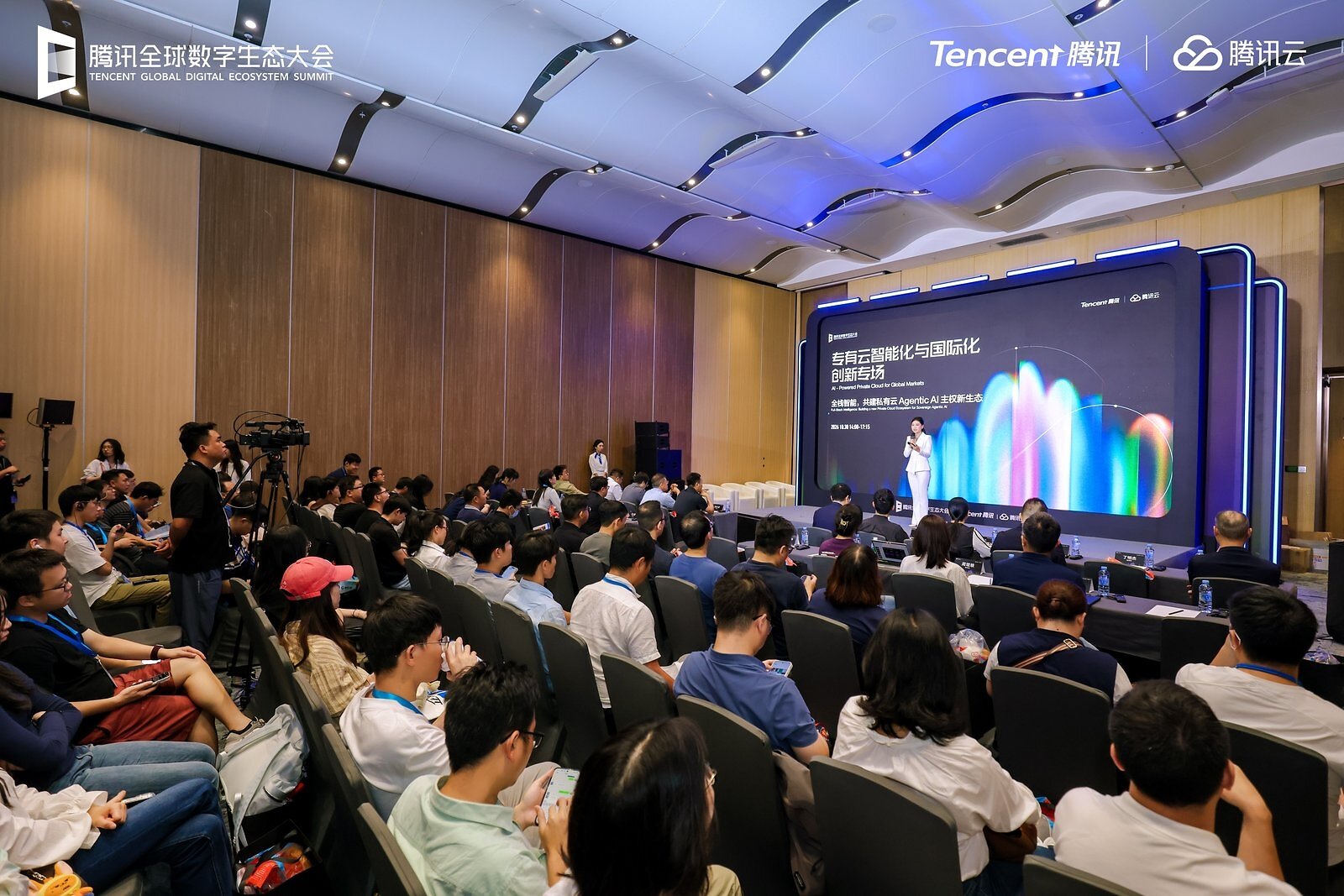
- Introducing two major solutions, the Full-Stack Intelligent AI Suite and Lite Deployment
- Announcing joint research with Gartner and Omdia
SHENZHEN, China, Nov. 6, 2026 — At the AI-Powered Private Cloud for Global Markets session of the 2026 Tencent Global Digital Ecosystem Summit, Tencent Cloud Enterprise (TCE) set out how highly regulated industries can run production-grade agentic AI inside their own boundaries. Under the theme "Full-Stack Intelligence, Sovereign AI," TCE launched two major solutions, the Full-Stack Intelligent AI Suite and Lite Deployment, as well as introducing the joint research reports with Gartner and Omdia.
"Once an agent starts touching core business data and calling critical systems, the question is no longer whether the model is strong enough," said Kaibo Sha, Vice President, Tencent Cloud. "It is where the data is processed, who operates the system, and what foundation the agent runs on. Full-stack intelligence is the capability we build. Sovereign AI is the boundary we keep."
Full-Stack Intelligent AI Suite — from token supply to agent runtime
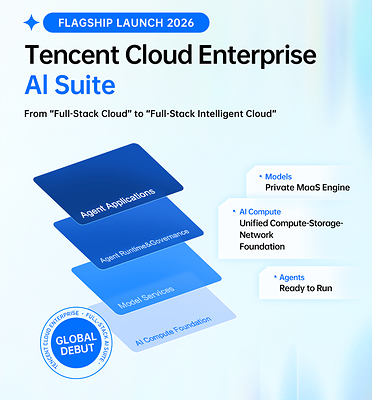
The Full-Stack Intelligent AI Suite, Tencent Cloud Enterprise's flagship release of the year, marks the shift from a full-stack cloud to a full-stack intelligent cloud. It spans four selectable layers — a converged compute, storage, and networking foundation; a model service layer built on TokenHub, the private MaaS platform for LLM services; an agent runtime layer with a cloud-native sandbox, egress control, and identity credentials; and an agent application layer. Customers can enter at any level and expand upward.
LLM Service TokenHub turns raw computing power into token services that are callable, meterable, and operable, published on a unified, industry-standard inference API with multi-tenant isolation and token-level metering down to individual users and API keys. Built-in inference acceleration delivers more than 250,000 TPM of measured single-accelerator throughput, cache hit rates above 90%, and up to 220% throughput gains on alternative silicon.
Across the suite, agent behavior is fully auditable, runtime environments are provisioned in minutes, and unified training and inference scheduling raises heterogeneous compute utilization by up to 60%. Data, model weights, and inference traffic never leave the customer's sovereignty boundary. The suite is compatible with mainstream x86 and ARM processors and multi-vendor accelerators, has been validated at 10,000-GPU scale, and delivers financial-grade resilience of RTO ≤ 2 minutes and RPO = 0.
Tencent Cloud Enterprise Lite Deployment — production-grade from eight servers
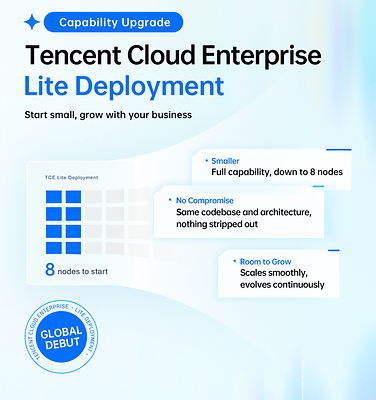
Tencent Cloud Enterprise Lite Deployment addresses what has become the decisive question in private cloud projects: how small a credible start can be. Hardware and operating costs keep rising, pilot-first is now the standard path, and budgets are committed in stages — yet a small footprint must still grow into production without re-platforming.
Lite Deployment delivers a complete full-stack cloud from eight servers — three master, three block storage, and two network function nodes — with no reduction in core IaaS capability. An AI-only entry point starts from three servers, with private model services out of the box. The same architecture then scales from a single availability zone to metro dual-AZ active-active and on to cross-region disaster recovery, ensuring the platform a customer validates on is the platform they scale. Delivered as software on existing hardware, it requires no capital-heavy refresh and carries no minimum spend.
One of the largest futures brokerages by brokered turnover and client assets took this route: a full-stack private cloud carrying core trading systems across heterogeneous chip architectures, with AI started on three servers and extended as volumes grew.
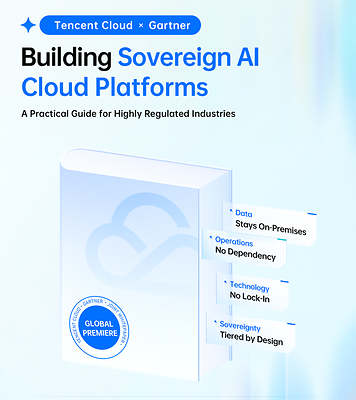
A Practical Guide to Building Sovereign AI Cloud Platforms, with Gartner
Tencent Cloud Enterprise and Gartner jointly released A Practical Guide to Building Sovereign AI Cloud Platforms, a reference for regulated industries building self-controlled AI platforms. It frames sovereignty as a spectrum resting on three pillars — data, operations, and technology — and sets out adoption paths for financial services, healthcare, public service cloud, and telecommunications.
Gartner research cited in the guide underlines the urgency: by 2028, strict data sovereignty and privacy regulations will compel over 25% of enterprises in regulated industries to repatriate their primary GenAI workloads on-premises; through 2029, dependence on proprietary foundation models will leave over 50% of GenAI adopters locked into a single public cloud provider's ecosystem; and only 17% of organizations report having enough talent to support AI adoption. (Full Report: https://intl.cloud.tencent.com/resources/whitepaper/101580)
Telco Cloud and AI Transformation, with Omdia
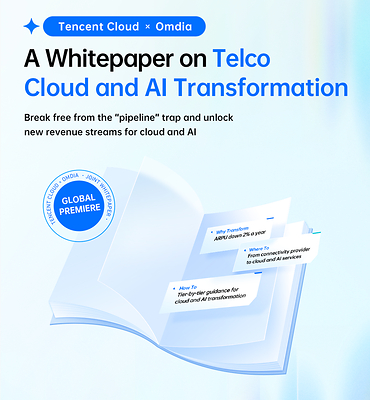
Tencent Cloud Enterprise and Omdia jointly released Telco Cloud and AI Transformation: Global Market Opportunities and Case Studies. The whitepaper documents the operator shift from connectivity provider to cloud and AI enabler, against mobile ARPU declining roughly 2% annually while OTT players capture more than 70% of network traffic value.
Omdia projects $160 billion in telco-led AI data center investment between 2026 and 2031, equivalent to 9% of combined fixed and mobile capex, and identifies three transformation trends: full-stack industry cloud platforms, national cloud infrastructure, and AI monetization beyond GPU-as-a-Service toward MaaS and token-based business models. It recommends that operators act now on the sovereign AI window and choose software-independent, hardware-open full-stack partners with proven white-labelling capability. (Full Report: https://intl.cloud.tencent.com/resources/whitepaper/101582)
Customer Practice Across Markets
Customers presented their own deployments at the session: Shanghai Xuhui District, on a multi-chip government cloud with tidal compute scheduling; Shenzhen Second People's Hospital, on a hospital-wide foundation for agentic AI in clinical, service and management workflows; and a large, diversified organization in Hong Kong, China, on migrating from VMware Tanzu to a cloud-native hybrid cloud on Tencent Cloud Enterprise. A Thai digital infrastructure provider, previously using VMware, launched two data centers on Tencent Cloud Enterprise in eight weeks and now runs a white-labelled, metered cloud business.
About Tencent Cloud Enterprise
Tencent Cloud Enterprise is a full-stack private cloud and industry cloud platform that brings capabilities validated at public cloud scale into environments under customer control. Delivered as software across open, heterogeneous hardware, Tencent Cloud Enterprise scales from three servers in AI-only deployments to tens of thousands of nodes, from public-cloud-connected to fully air-gapped environments.